
Air
pollution has significant effects on exacerbation of asthma, allergy and other
respiratory diseases. There is a great need to implement control measures in
most of the megacities of the world to improve air quality and hence protect
public health. Like many other megacities in the world the ambient air quality
of Chittagong is also being deteriorated day by day. Main sources of air
pollution in this city are arising out of the emission from the motor vehicles,
industries, galvanisms, etc. Considering the severity of the problem, the
current study plan was undertaken to measure the gaseous pollutants level in
the air of different urban locations of Chittagong, the second largest city of
Bangladesh. Atmospheric pollutants like gaseous (SO2, NO2), particulate matters
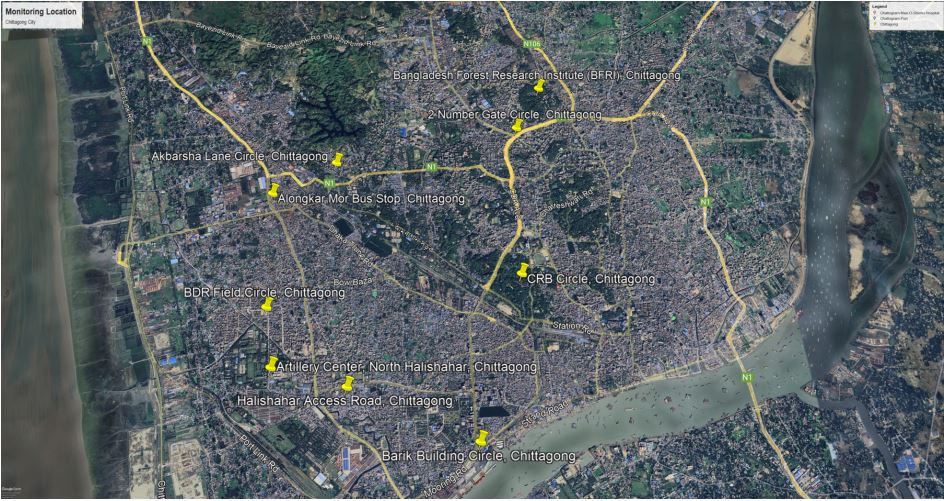
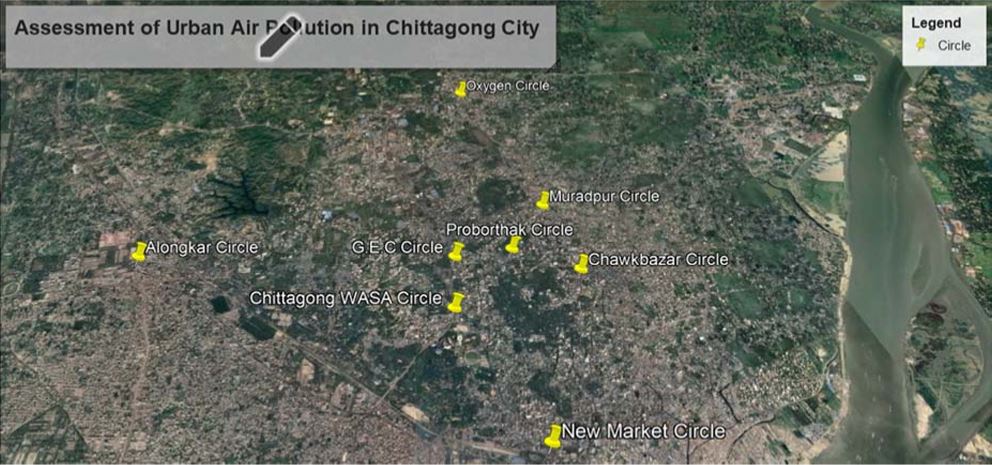
(SPM) were determined in Chittagong city. Eight different sampling stations,
Muradpur Circle, WASA Circle, G.E.C Circle, Proborthak Circle, Chawk-bazaar
Circle, Olongkar Circle, New Market Circle and Oxygen Circle were selected for
sample collection and observations during the atmospheric year 2013 -2014. The
objective of the study was to determine the concentrations of gaseous
pollutants (SOx, NOx) and particulate matters (SPM, PM2.5 and PM10) to find out
the variation of air pollutants in different locations of Chittagong city. The
concentration of gaseous pollutants was found more at highly traffic areas. The
highest concentration value of SO2, NO2and SPM was observed in highly traffic
area at Muradpur Circle, Olongkar Circle & New Market Circle, respectively.
The lowest concentration value was found in less traffic area at WASA Circle
& Proborthak Circle. The average results of gaseous pollutants, particulate
matters and trace metals have been compared to national and international
standards. The value of SPM in air of Chittagong city is higher than that of
TLV value recommended by WHO and DOE. The elemental concentrations (e.g. Cd,
Co, Cr, Cu, Fe, Pb, Hg, Ni and Zn) of ambient air that collected at different
locations in Chittagong city is exceeded the TLV. A strategic air quality
management plan has been proposed.
For full article - jubaer.ahmed@eqmscl.com
Share this page via
More from Ahmed Jubaer